 Skip to content


Pool cage repair vs replacement in Fort Myers depends on the damages, for example – isolated screen problems may need repair, while widespread mesh, bent framing, or failed anchors require a broader assessment.
A torn screen is easy to notice from the patio. The condition of the aluminum frame, fasteners, doors, roof edge, building attachment, and concrete connections is harder to judge. That distinction matters because new mesh cannot correct a cage that has shifted, separated, or lost structural support.
The right scope usually falls into one of four paths:
- Targeted repair for a limited defect
- Partial or full rescreening when the frame remains suitable
- Structural repair when damage is localized to aluminum, hardware, or connections
- Replacement or rebuilding when the existing structure cannot be restored reasonably
A professional pool cage and screen-enclosure service can help define the scope before a property owner pays for work that does not address the underlying problem.
Contents of the page
- Repair, rescreening, structural repair, or replacement?
- How to inspect a pool cage from screen to foundation
- When does targeted repair make sense?
- When is full rescreening better?
- Can bent aluminum pool-cage frames be repaired?
- When is replacement or rebuilding the better path?
- What should you check after hurricane or storm damage?
- How much does pool cage repair versus replacement cost?
- What should a pool-cage estimate include?
- Frequently asked questions
Repair, rescreening, structural repair, or replacement?
The right choice depends on which part of the enclosure has failed. A screen repair addresses mesh or spline. Rescreening replaces worn mesh across a larger area. Structural repair addresses aluminum, fasteners, anchors, doors, or connections. Replacement rebuilds all or a substantial part of the enclosure when preserving the existing structure is no longer practical.
| What you see | Likely scope to investigate | What it does not automatically prove |
| One or a few torn panels | Targeted screen repair | That the rest of the enclosure is sound |
| Brittle, faded, sagging mesh across many panels | Partial or full rescreening | That the frame and anchors are suitable without inspection |
| Rusted fasteners, loose spline, or a dragging door | Hardware or localized repair | That the frame has not shifted |
| Bent beams, separated anchors, or widespread corrosion | Structural repair or replacement evaluation | That a new screen will correct the condition |
| Storm damage across several elevations | Full condition assessment | That the visible panel damage is the complete scope |
The table is a starting point, not a structural diagnosis. A site review should confirm what the damage includes before the work is selected.
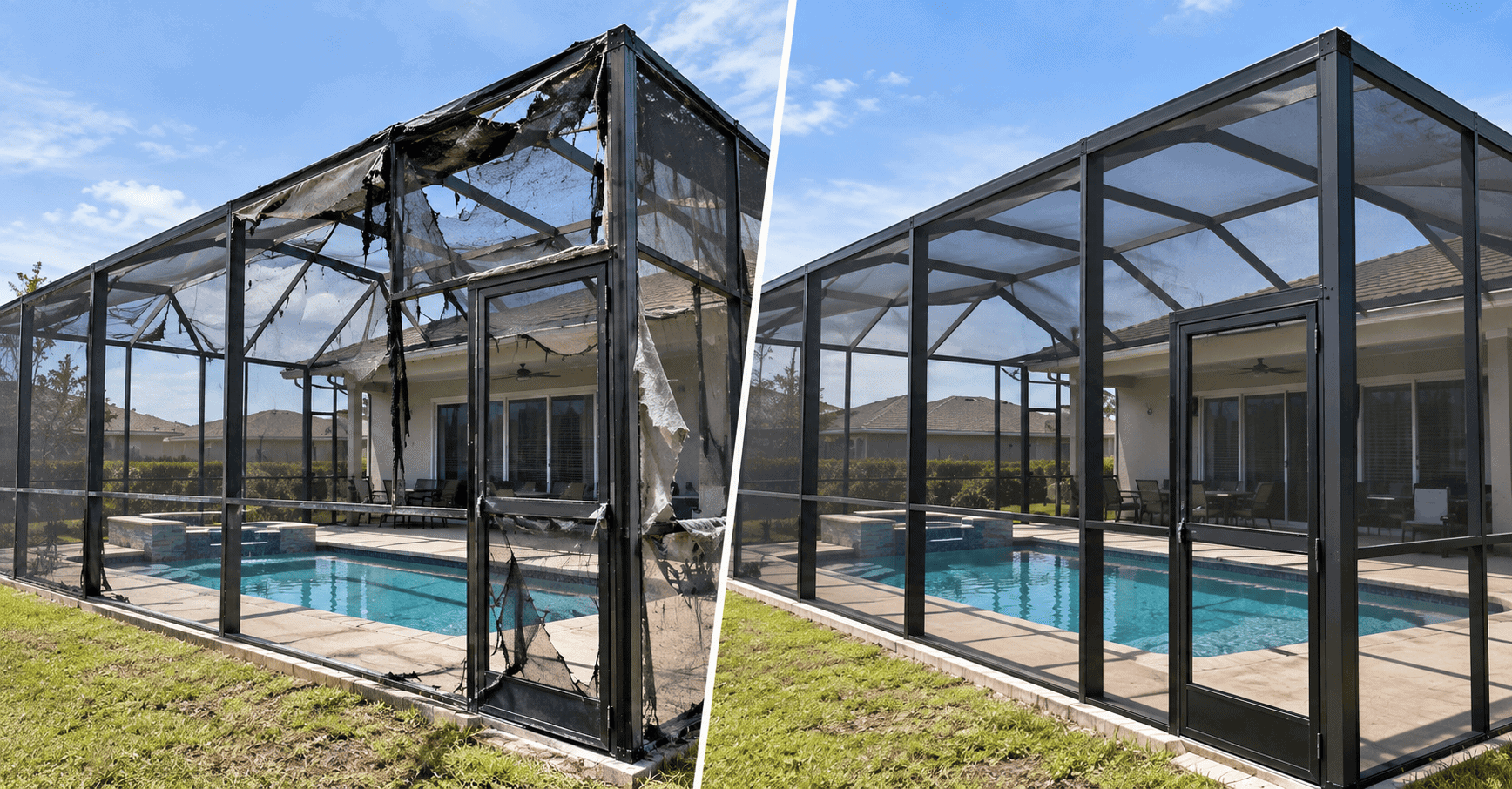
How to inspect a pool cage from screen to foundation
A useful inspection works from the outer layer inward. Looking only at torn mesh can miss the condition that caused it to fail.
1. Screen panels and spline
Check for isolated tears, widespread fading, brittle mesh, sagging panels, and screen pulling out of the channel. A few accidental tears may be a repair issue. Mesh that fails in several areas may have reached the end of its serviceable life.
2. Fasteners, doors, and hardware
Look for rusted or missing screws, loose hardware, broken door components, dragging doors, and openings that no longer latch cleanly. Hardware problems can be repairable, but a door that is out of square may also indicate frame movement.
3. Aluminum framing
Check beams, posts, roof members, joints, and corners for bending, twisting, pitting, or separation. A frame can look acceptable at ground level while a roof or corner connection has moved.
4. Anchors, attachments, and concrete
Inspect where the enclosure meets the slab, deck, house, roof edge, or super gutter. Loose anchors, failed connections, cracking around posts, or separation from the building require more than a rescreening decision.
When does targeted repair make sense?
Targeted repair makes sense when the defect is limited and the surrounding enclosure remains serviceable. Examples may include:
- One or a few torn screen panels
- A damaged screen door panel or hardware
- Isolated spline failure
- Limited fastener replacement
- One localized, repairable aluminum issue
- A small storm-damaged section after the structure has been checked
Before approving a small repair, confirm that the surrounding mesh is not brittle, the frame is straight, the spline channel is usable, and the fasteners are not failing throughout the enclosure.
A repair can be the right answer when it restores one defect without ignoring a connected problem. If new tears appear shortly after earlier repairs, the screen may be failing generally or the frame may be moving.
When is full rescreening better?
Full rescreening is usually the more logical path when the mesh has worn out across a meaningful portion of the enclosure but the aluminum frame and attachment points remain suitable to retain.
Signs that rescreening may fit include:
- Widespread fading or brittleness
- Multiple tears across different elevations
- Mesh pulling away from the frame channel
- Sagging or loose panels across the enclosure
- Repeated failures in otherwise straight framing
- Spline that has hardened, broken, or lost its grip
Rescreening replaces mesh and related components. It does not straighten a racked frame, restore a failed anchor, or correct a damaged building attachment. Those conditions should be addressed before new screen is installed.
The right mesh also depends on the property. Visibility, smaller-insect protection, pets, privacy, sun exposure, coastal conditions, and replacement availability may all affect the choice. A product should be selected for the enclosure’s use rather than described as universally best.
Can bent aluminum pool-cage frames be repaired?
Sometimes, but the answer depends on which member is bent, how far it has moved, what connects to it, and whether the surrounding structure remains sound.
A localized member or connection may be repairable when the rest of the frame is aligned and the repair can restore the intended geometry. A cage that is racked, twisted, separated from the slab, or damaged at several connected points is a different problem.
A frame assessment should consider:
- Bent or twisted beams and posts
- Open or displaced connections
- Corrosion at structural joints
- Loose or pulled anchors
- Doors that no longer align
- Roof sections that sag or sit out of square
- Damage where the enclosure meets the house or roof edge
Do not use filler, paint, or a DIY patch to hide a structural problem. The repair method should match the aluminum, connection, access, and applicable project requirements.
When is replacement or rebuilding the better path?
Replacement deserves consideration when structural damage is widespread, the original geometry cannot be restored reasonably, or the existing enclosure cannot support the desired result.
Common indicators include:
- Multiple bent or twisted members
- Failed or moving anchors
- Corrosion at important structural connections
- Widespread storm deformation
- Repeated repairs that have not solved the problem
- A failed roof edge or building attachment
- A major change in enclosure size, height, layout, or opening design
- A foundation or slab connection that needs a separate review
Age alone does not prove that a pool cage needs replacement. A maintained frame may outlast several sets of screens. Conversely, a newer enclosure can need significant work after a severe storm or connection failure.
What should you check after hurricane or storm damage?
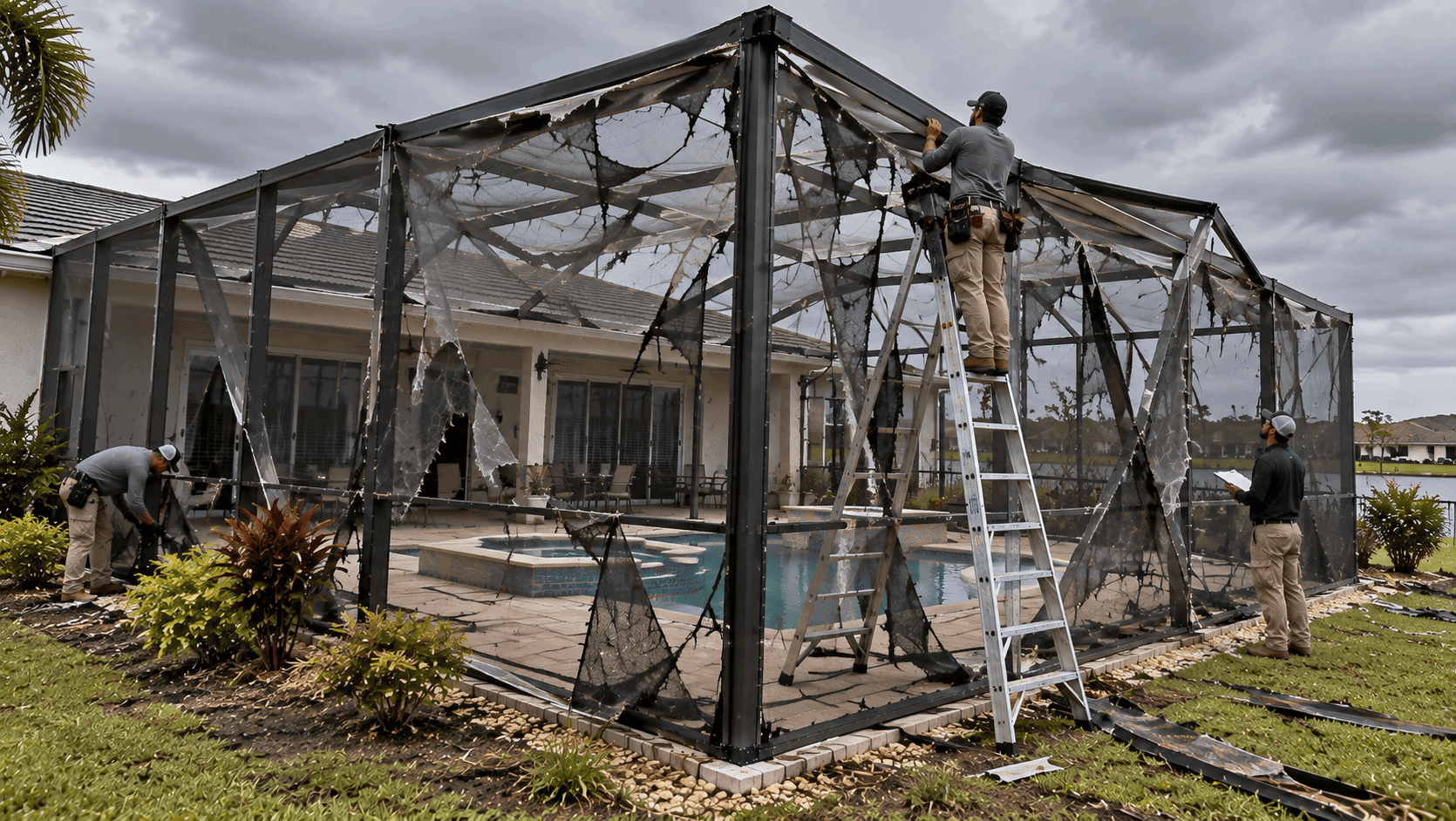
After a storm, document the enclosure before choosing a repair path. Look beyond the missing mesh.
- Photograph every damaged wall and roof section.
- Check for bent members, shifted doors, loose connections, and separated anchors.
- Look at the roof edge, super gutter, and building attachment for visible movement or water entry.
- Note missing panels, loose spline, damaged hardware, and frame movement.
- Keep photographs and visible damage records available for the project file.
- Ask whether the proposed scope includes structural inspection, permitting, engineering, and final inspection where applicable.
- Do not assume that a rescreen will correct frame or anchor damage.
Insurance decisions are policy-specific. A contractor can document visible conditions and help define the repair scope, but coverage and claim approval belong to the policyholder, carrier, and adjuster.
How much does pool cage repair vs replacement cost?
There is no reliable single Fort Myers price because the scope can range from one screen panel to a complete engineered enclosure rebuild. A useful comparison is based on the work included, not only on the lowest starting number.
| Scope | Relative cost level | What it may include | Main cost variables |
| Targeted screen or door repair | Lowest | One or several panels, spline, door mesh, or hardware | Access, height, number of panels, screen type |
| Partial rescreening | Low to medium | Selected wall or roof panels and spline | Panel count, roof access, mesh, fasteners |
| Full rescreening | Medium | Removal and replacement of mesh across the enclosure | Size, height, screen material, frame condition |
| Aluminum or connection repair | Medium to high | Members, fasteners, doors, anchors, or localized structural work | Extent of damage, access, engineering, concrete condition |
| Structural replacement or rebuild | Highest | Demolition, fabrication, engineering, permits, installation, inspection | Size, geometry, wind requirements, attachments, site conditions |
A complete estimate should state what is included, what is excluded, whether engineering or permits are required, how damaged material is handled, and what final documentation is provided. Online price ranges should not replace a site-specific scope.
What should a pool-cage estimate include?
Ask whether the estimate identifies:
- Screen, spline, and panel replacement
- Door and hardware work
- Fastener replacement
- Aluminum-frame repair or replacement
- Anchor and connection conditions
- Super-gutter or roof-edge work
- Building-attachment concerns
- Demolition and disposal of damaged components
- Screen material and warranty
- Permit, engineering, and inspection responsibilities where applicable
- Cleanup and final walkthrough
- Exclusions and conditions that could change the scope
Two estimates may differ because they describe different levels of work. Compare the inspection findings and inclusions before comparing the totals.
Does a pool-cage repair require a permit in Fort Myers?
Do not assume that every screen-related job follows the same permit path. Simple mesh or spline work may be treated differently from structural framing, enclosure replacement, additions, or work that changes the design.
The current Florida building-code system and the local authority having jurisdiction should be checked for the specific property and scope. The Florida Building Codes and Standards information explains the statewide code system; local requirements and project documents determine the applicable process.
A written proposal should make clear who handles permit coordination, engineering documents, inspections, and final closeout.
Frequently asked questions
Should I repair or replace my pool cage after a storm?
Start with an inspection of the screen, frame, fasteners, anchors, roof edge, building attachment, and concrete connections. A few damaged panels may need repair; widespread mesh failure may need rescreening; structural damage may require a replacement evaluation.
Can a pool-cage frame be repaired if it is bent?
Sometimes, if the damage is localized and the surrounding structure remains sound. A racked frame, separated anchor, widespread corrosion, or connected member damage requires a more complete review.
Can I replace only one pool-cage panel?
Often, when the surrounding mesh, spline, frame, and hardware remain serviceable. If nearby panels are brittle or repeatedly tearing, a broader rescreening scope may make more sense.
How long do pool-cage screens last in Florida?
There is no universal lifespan. UV exposure, storms, screen material, humidity, coastal conditions, pets, cleaning, and installation quality all affect serviceability.
Are pool-screen enclosures covered by insurance?
Coverage depends on the policy, cause of damage, exclusions, documentation, and the insurer’s adjustment. Do not assume coverage or claim approval from storm damage alone.
Does replacing the screen fix a bent frame?
No. New screen replaces mesh. It does not straighten a racked frame, restore a failed anchor, or correct a damaged building connection.
Make the repair decision from the structure outward
The correct choice is not always the most expensive option. It is the scope that matches the condition:
- Repair isolated damage when the enclosure remains sound.
- Rescreen when the mesh has failed but the frame and connections are suitable.
- Repair or reinforce aluminum when the structural issue is localized and repairable.
- Rebuild or replace when damage is widespread or the existing structure cannot support the desired result.
For a Fort Myers or Southwest Florida property, pool cage and screen-enclosure services can be the next step after the condition has been documented and the scope is clear. To discuss a project, request a pool-cage assessment with the visible damage, property location, and intended work available for review.


