Skip to content


A pool can be a strong fit, but it is not an automatic value or rent upgrade. First test market fit, site feasibility, all-in cost, maintenance, permits, and who will operate it.
Many pool articles start with the promise: more buyer interest, higher rent, a better resale price, or a resort-style lifestyle. Those outcomes may be possible in the right property, but they are not guaranteed by the presence of water in the backyard. A pool can improve one investment property’s appeal and create an expensive operating obligation on another.
For an owner comparing pool construction in Fort Myers or elsewhere in Southwest Florida, the first question is not which tile looks best. Start with a site-specific scope that includes the relevant pool construction and remodeling services, then ask whether the property has a defensible reason for the pool, a workable site, a complete construction budget, and a person who will operate it after handoff.
This guide uses ROI as a decision framework, not as a promised percentage. It separates property value, rental performance, personal use, and operating efficiency so the owner can evaluate the project without relying on a generic national claim.
The investor answer in one paragraph
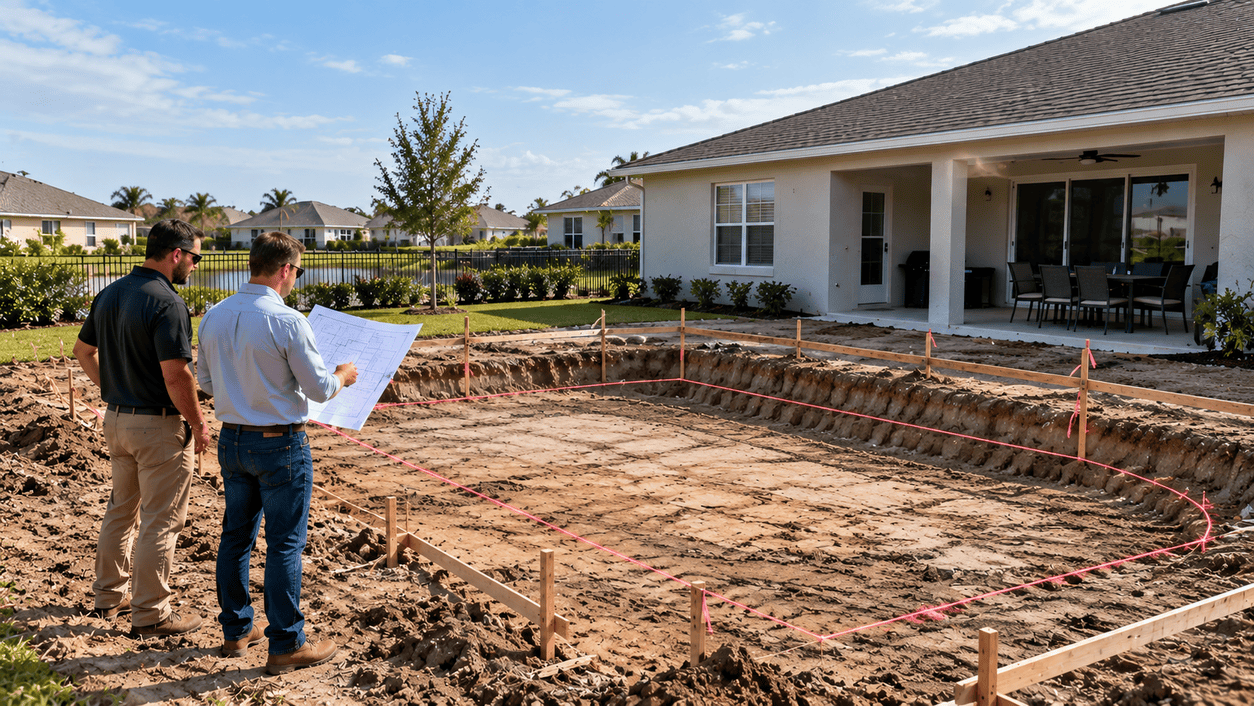
A pool deserves serious consideration when comparable properties and the intended occupants support it, the site can accommodate the complete project, the all-in budget includes more than the pool shell, and the owner has a practical plan for cleaning, repairs, access, safety, and records. If the project only works when rent, vacancy, resale, or maintenance costs improve by an unverified amount, the investment case is not ready.
That does not mean a pool is a bad decision. It means the decision should be made from the property outward, not from a feature brochure inward.
What kind of return are you actually evaluating?
“ROI” can mean different things in a pool decision. A sale benefit, rental appeal, owner enjoyment, and lower operating burden are not interchangeable, and they should not be entered into an investment model as though they were the same result.
| Return lens | The question to ask | Evidence or information needed |
| Sale or exit appeal | Will the finished property compare better with similar local properties when it is sold or refinanced? | Comparable properties, condition, permitted work, outdoor presentation, and local professional feedback. |
| Rental appeal | Is the pool relevant to the target occupants, and can the owner manage the added responsibility? | Comparable rental listings, property-manager input, use rules, service plan, and operating categories. |
| Owner or guest use | Will the pool be used enough to justify the personal or guest benefit? | Intended use, season, layout, accessibility, seating, shade, and maintenance tolerance. |
| Operating efficiency | Can the pool be serviced, monitored, repaired, and documented without unnecessary friction? | Equipment access, controls, service route, utilities, repair reserve, and assigned responsibility. |
A pool can perform well in one category and poorly in another. An owner may value a pool highly for personal use even if the rental market does not support a large rent change. A rental property may receive more inquiries while also adding service, safety, insurance, and access obligations.
Why a generic pool ROI percentage is not a Fort Myers forecast
A percentage published for another market may use different property types, sale prices, pool materials, data dates, calculation methods, and buyer expectations. A commercial renovation percentage is not automatically relevant to a single-family rental. A resale premium is not the same as an increase in monthly rent. A lifestyle benefit is not a cash return.
Use broad figures as background reading only. For a property-specific decision, document:
- What nearby comparable properties offer
- Whether the pool is expected, unusual, or irrelevant for the intended market
- The complete installed cost, including site and outdoor work
- Ongoing service, utility, repair, and replacement categories
- Who will operate and access the pool
- What records and permits will exist when the property is sold or refinanced
Decision 1: Does the local property market support the amenity?
Before choosing a pool shape, compare the property with nearby homes or rentals that compete for the same buyers or occupants. A pool may be a meaningful differentiator in one neighborhood and a basic expectation in another. It may also be irrelevant if the property has more important condition, layout, location, or management problems.
A practical market-fit review
Look at comparable properties by:
- Location and neighborhood
- Property type and size
- Price or rent range
- Outdoor space and existing amenities
- Pool condition and enclosure quality
- Intended use, such as long-term, seasonal, or permitted short-term occupancy
- Maintenance presentation and property-management arrangement
Ask a local real estate professional or property manager what they see in actual transactions or leasing activity. Their input is not a substitute for a construction estimate or permit review, but it is more relevant than assuming that every Southwest Florida property receives the same benefit from a pool.
What does a pool add when the rest of the property is not ready?
A pool rarely fixes a weak property by itself. If the home needs major repairs, the outdoor circulation is awkward, the deck is deteriorated, or the pool area looks poorly maintained, the water feature may not create the impression the owner expects.
Think of the pool as part of a property package:
Home condition + outdoor layout + pool + deck + enclosure + equipment + maintenance records
The pool should strengthen that package rather than compete with unresolved problems elsewhere.
Decision 2: What operating model will use the pool?
A pool for a long-term rental, seasonal home, short-term rental where permitted, owner-occupied property, or multi-unit asset has a different operating model. The use case should be written down before the design is finalized because it affects access, durability, rules, service, records, and who approves repairs.
Long-term rental
The owner or property manager should be able to answer five basic questions:
- Who performs or schedules routine cleaning and water care?
- Who can access the equipment pad and enclosure?
- Who reports damage or unsafe conditions?
- Who approves repairs that exceed routine service?
- How is the pool checked between tenants?
A pool may appeal to some occupants and deter others. Do not assume that every tenant will pay more for it or use it often enough to justify the operating burden. Check the property type, target market, lease structure, and local management experience.
Seasonal or second home
An owner who is away needs a local person or service arrangement for water, equipment, storm, enclosure, and drainage checks. The equipment location should not require an unusual access procedure every time a service provider needs to inspect a pump, filter, control, valve, or electrical component.
Short-term rental, where permitted
Short-term use can bring more frequent turnover, more guest instructions, more access questions, and a different insurance and community-review process. Verify local and private restrictions before using a pool as part of the property strategy. Design the pool for the approved use, not for an assumed use that may not be allowed.
Multi-unit or commercial property
A shared or commercial pool may involve public or shared use, accessibility planning, health requirements, staff procedures, higher traffic, and different inspection responsibilities. Do not transfer a commercial pool-renovation claim to a single-family investment property without checking the property classification and applicable requirements.
Decision 3: Should you build new, buy a property with a pool, or remodel one?
The cheapest-looking path is not always the lowest-risk path. A new pool creates a large initial scope, while an existing pool can carry hidden deterioration, outdated equipment, incomplete records, or drainage and enclosure problems.
If you are buying a property with an existing pool
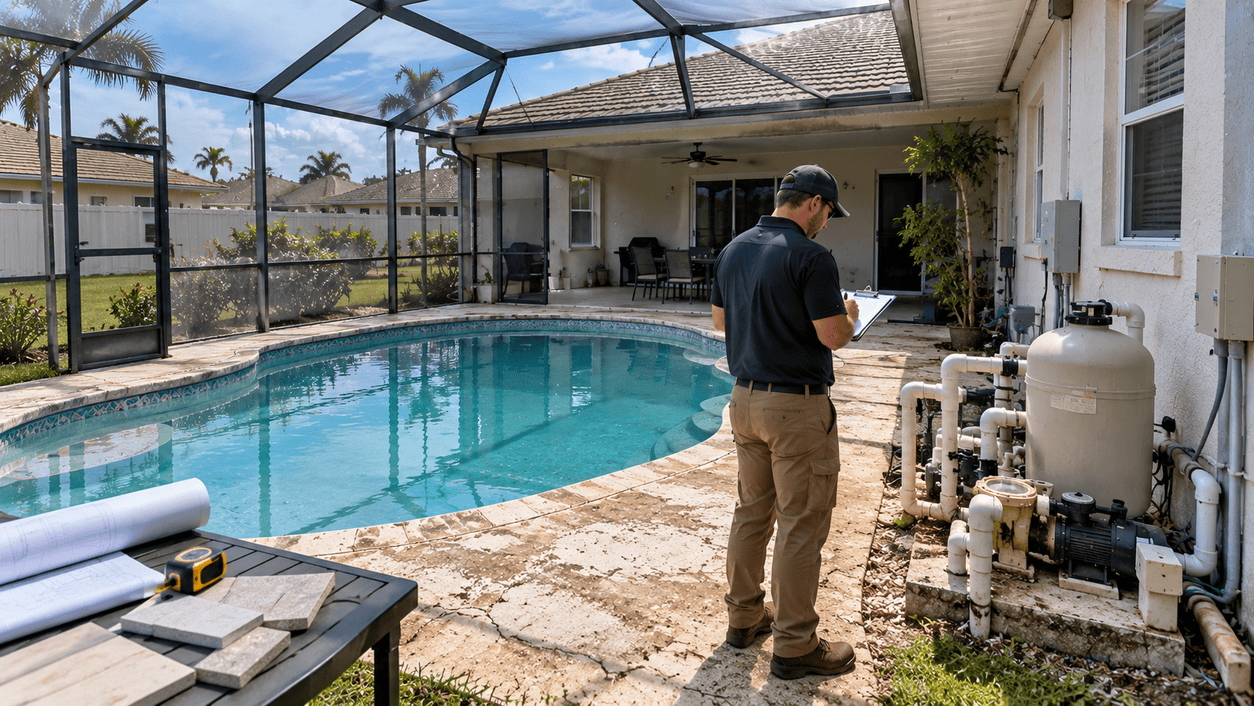
Treat the pool as a separate due-diligence system. Review, where available:
- Pool shell and visible structure
- Plumbing and circulation equipment
- Electrical components and controls
- Interior finish, tile, coping, and deck
- Drainage around the pool and nearby structures
- Screen enclosure, doors, framing, anchors, and attachments
- Permit and inspection records
- Service records, repair history, equipment models, and replacement availability
Clean water is not a structural assessment. A pool can look attractive while the owner still needs to investigate equipment age, deck drainage, enclosure connections, or a history of repairs.
If you are building new
New construction allows the owner to coordinate the pool, deck, enclosure, equipment pad, access route, drainage, and finished elevations from the beginning. That control is valuable, but only if the estimate includes the complete project rather than only excavation and the pool structure.
If you are remodeling an existing pool
A remodel may involve resurfacing, tile, coping, equipment, deck work, drainage corrections, or several of these at once. The proposal should separate cosmetic improvements from structural, plumbing, electrical, and site conditions.
| Property condition | Path to investigate | What the investigation should answer |
| No pool exists | New construction | Can the property support the complete footprint and construction route? |
| Shell appears sound, finish is worn | Resurfacing or limited remodeling | Is the shell, plumbing, coping, and equipment suitable for the planned result? |
| Pool, deck, and equipment are all dated | Coordinated remodel | Which components are retained, replaced, or deferred? |
| Layout or location no longer works | Major redesign or new-construction evaluation | Can the desired use be achieved without carrying forward the site’s limitations? |
| Structural or plumbing condition is unclear | Assessment before choosing scope | Which conditions are known, assumed, or hidden until work begins? |
If the enclosure is part of the decision, the existing guide on pool cage repair versus replacement in Fort Myers explains why screen damage, frame movement, fasteners, anchors, doors, and connections can require different work. It supports the enclosure decision without turning this article into another repair guide.
Decision 4: Can the Southwest Florida site support the complete project?
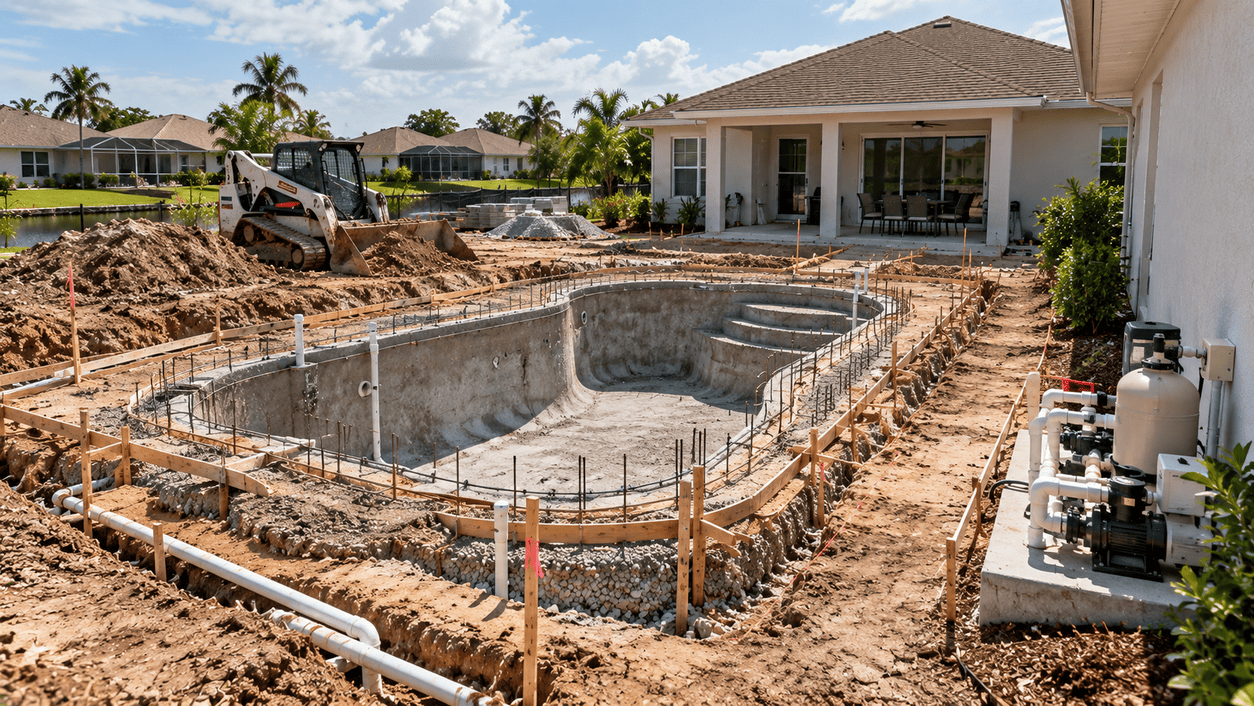
A site is not ready simply because a pool footprint fits on a sketch. The site must also support excavation, equipment movement, material staging, soil removal, deck construction, enclosure installation, service access, drainage, finished grades, and restoration.
Site factors that can change the scope
| Site factor | Why it matters before construction |
| Footprint, setbacks, and easements | The visible yard may not equal the legally or practically usable area. |
| Access and staging | Fences, walls, narrow side yards, mature landscaping, and nearby structures can change equipment and delivery planning. |
| Soil, fill, rock, and groundwater | Subsurface conditions may affect excavation and site-preparation assumptions. |
| Slope and finished elevations | The pool, deck, house, enclosure, and yard must meet without creating an unresolved grade problem. |
| Drainage and runoff | New surfaces and grades can change how water moves near the pool, home, and equipment area. |
| Utilities and existing structures | Excavation must account for utility conflicts, trees, patios, walls, and nearby buildings. |
| Restoration | Disturbed paving, landscaping, fences, and access areas need a defined responsibility. |
Why a site visit should ask about the route, not only the footprint
Ask where equipment enters and leaves, where excavated material goes, how existing surfaces are protected, where materials are staged, and who restores disturbed areas. A proposal that assumes “normal access” without describing the route leaves a major variable unresolved.
For example, a narrow side yard can affect more than excavation. It can also affect deck material delivery, screen-enclosure installation, future equipment replacement, and cleanup. That is why access belongs in the initial scope.
Can a pool be built on a sloped property?
A sloped property can be evaluated, but the slope may affect grading, drainage, deck elevations, access, structural design, enclosure connections, and neighboring structures. The right answer comes from the site and design conditions, not from a universal yes or no.
Why deck drainage should be decided before finishes
The deck is part of the finished-grade and runoff plan around the pool. Discuss its relationship to doors, thresholds, walkways, walls, the home, the enclosure, and existing drainage features before the surface is selected.
A drainage question discovered after the deck is installed is a scope problem, not a decoration problem.
Decision 5: What design creates usable value instead of unnecessary complexity?
An investment-property pool should be durable, serviceable, appropriate for the property, and broad enough to fit its intended market. Extra features may improve a specific use case, but they can also add cost, service points, replacement needs, or a narrower appeal.
Design questions worth asking
- Is the pool the right size for the property and intended users?
- Does the entry, depth, seating, or shallow area support the use plan?
- Can the deck provide circulation, outdoor use, and service access?
- Is the finish appropriate for the environment and future care?
- Can the equipment pad be reached without disrupting occupants?
- Will heating, automation, lighting, or water features have a clear use or operating reason?
- Does the enclosure fit the pool, deck, doors, attachments, storm exposure, and future maintenance plan?
For a new build, review pool cage and screen-enclosure options before the pool and deck footprint are locked. The enclosure should not be a late add-on that forces a redesign or leaves equipment and service paths unclear.
Design for the property, not for a generic image
A pool that looks impressive in a photograph may still be a poor investment if it consumes the most usable part of the yard, blocks service access, creates difficult transitions, or requires features the owner cannot maintain.
The better question is not “What is the most luxurious pool?” It is “What pool, deck, enclosure, and equipment plan will remain useful and maintainable for this property?”
Decision 6: What belongs in the all-in project budget?
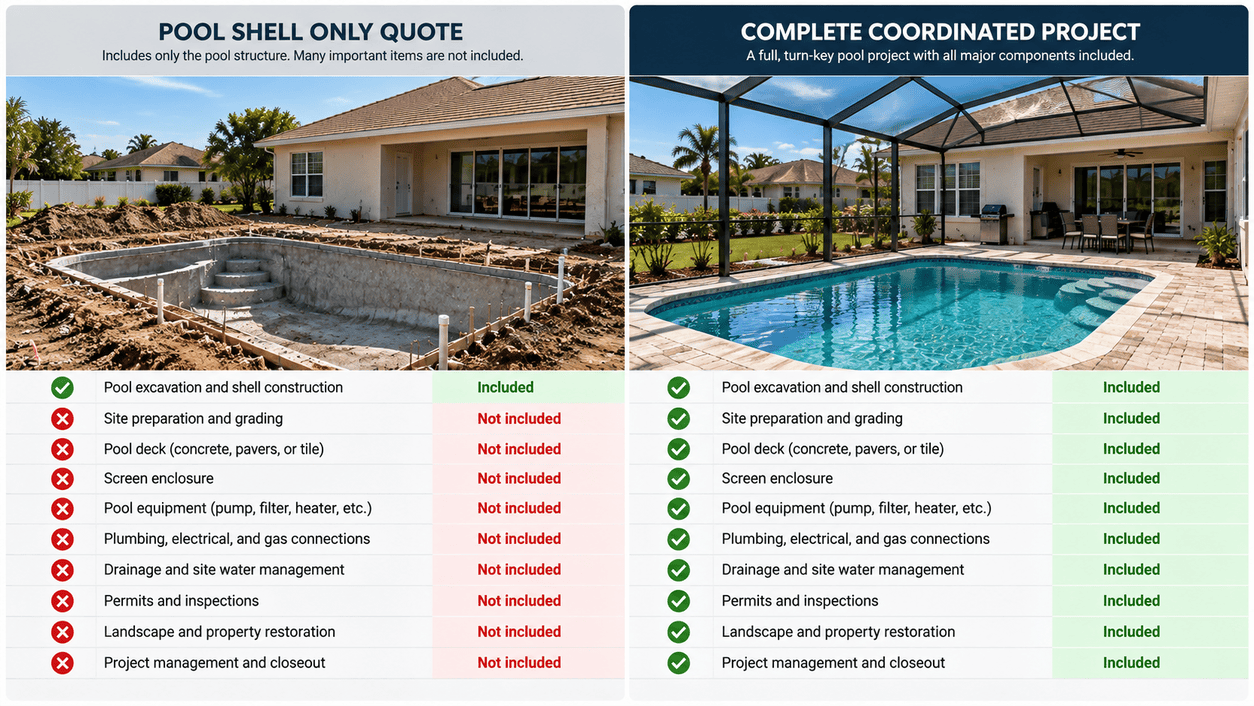
The financial case should use the complete project, not only the pool-shell line. A realistic budget includes planning, permits, site work, construction, deck, enclosure, equipment, drainage, restoration, closeout, and a reserve for ownership.
| Cost layer | Items to identify in the written scope |
| Planning and approvals | Site assessment, design documents, permits, inspections, HOA or community review, and applicable fees. |
| Site preparation | Access, staging, protection, excavation, removal, soil or groundwater assumptions, utilities, grading, drainage, and restoration. |
| Pool construction | Structure, plumbing, electrical coordination, finish, tile, coping, steps, benches, and selected features. |
| Outdoor package | Deck, transitions, screen enclosure or cage, doors, equipment pad, and surrounding site work. |
| Equipment and controls | Pump, filter, sanitation, heating, automation, lighting, controls, and service access. |
| Closeout | Cleanup, startup or handoff responsibilities, equipment information, maintenance instructions, inspection status, and records. |
| Ownership reserve | Cleaning, water care, utilities, service, repairs, storm checks, screen or deck work, and future replacement. |
What is usually the most expensive part?
There is no universal answer. Access, excavation, subsurface conditions, structural work, the pool shell, deck, enclosure, equipment, electrical coordination, drainage, and restoration can each drive the scope on a particular property.
A good estimate identifies what was observed, what was assumed, what is included, and what happens if an unexpected condition appears. It does not hide uncertainty inside a single number.
A decision model that does not pretend to know the future
Use this as a screening model, not a guaranteed financial forecast:
Documented local market fit and expected use
+
Complete project quality and usable outdoor space
–
Installed cost, operating cost, repair reserve, and management burden
=
Proceed, revise, phase, or pause
For a sale or refinance, compare similar local properties and account for pool condition, permits, documentation, and the quality of the complete outdoor package. For a rental, separate actual comparable-market evidence from assumptions about rent, occupancy, or tenant retention. For personal use, record the lifestyle benefit separately from the financial case.
Do not count the same assumed pool benefit twice, such as treating one pool as a guaranteed rent increase and a guaranteed resale premium.
Decision 7: Who will maintain the pool after handoff?
The owner should assign operating responsibility before construction starts. Cleaning, water care, equipment service, screen and deck checks, storm preparation, repairs, access, tenant communication, and records cannot be left to an unnamed future person.
Maintenance categories to plan
| Responsibility | Question to settle before construction |
| Cleaning and water care | Who performs routine service, testing, debris removal, and recordkeeping? |
| Equipment | Who can reach the pad, controls, valves, pump, filter, and connections? |
| Deck and finish | What care instructions apply to the selected materials? |
| Enclosure | Who checks screen panels, doors, framing, anchors, and storm damage? |
| Vacancy or seasonal periods | Who checks the property when the owner is away or the home is empty? |
| Tenant turnover | What is inspected, photographed, recorded, and communicated? |
| Repairs and reserve | Who approves additional work and where are records stored? |
| Insurance and rules | Which questions must be reviewed with the insurer, manager, HOA, and appropriate professional? |
There is no single monthly maintenance number that applies to every pool. Size, equipment, heating, automation, use, service arrangement, water treatment, utilities, repairs, enclosure, and local conditions all affect the ownership burden.
A pool can be an amenity and a liability at the same time. Planning is stronger when both sides are documented.
Decision 8: What permits, inspections, and approvals apply?
Requirements depend on the property’s jurisdiction, pool and enclosure scope, associated electrical and plumbing work, site improvements, property classification, and community rules. No single Southwest Florida permit statement applies to every property.
For a property inside the City of Fort Myers, begin with the City’s permit guidance and confirm current requirements with the building department. The official pool and spa permit application asks for information such as property type, pool type, construction type, work description, contractor information, and owner or applicant information. It also notes that associated electrical and other work may require separate permits.
Ask about:
- Pool or spa permits
- Structural or engineering documents where applicable
- Electrical and plumbing coordination
- Applicable safety barrier requirements
- Deck, patio, wall, fence, or site-improvement approvals
- Screen enclosure or cage permits
- Grading and drainage work
- Utility and easement concerns
- HOA, condominium, or community approval
- Required inspections and final closeout
“Permits included” should identify who prepares documents, submits the application, responds to corrections, schedules inspections, pays listed fees, and provides closeout records. It should also explain what happens if a correction changes the scope.
What should a pool construction estimate and contract include?
A complete proposal should let the owner understand what is being built, what is assumed, what is excluded, what can change, and what will be delivered at handoff. The total price matters, but scope clarity comes first.
Site and access
- Access route and staging assumptions
- Protection or removal of fences, walls, paving, landscaping, and existing features
- Excavation and material removal
- Soil, rock, groundwater, and utility assumptions
- Grading, drainage, and restoration
Pool and outdoor scope
- Pool layout, depth, entry, benches, and selected features
- Structure, plumbing, electrical coordination, finish, tile, and coping
- Equipment pad, pump, filter, sanitation, heating, automation, and controls
- Deck footprint, surface, elevations, transitions, and drainage
- Screen enclosure or cage, doors, attachment points, and related work
- Lighting, water features, and other selected options
Approvals, changes, and handoff
- Permit preparation, submission, inspection, and closeout responsibilities
- Allowances, selection deadlines, and owner-supplied items
- Exclusions and site-condition assumptions
- Change-order procedure and approval authority
- Cleanup, startup, maintenance instructions, equipment information, and final walkthrough
Compare proposals line by line. Mark each item included, excluded, an allowance, owner-supplied, pending site information, or subject to a written change order.
Pay attention to phrases such as “standard equipment,” “complete deck,” “normal access,” “permit included,” or “landscaping by owner.” Ask what each phrase means for this property.
The investor’s go, investigate, or pause scorecard
| Question | Go signal | Investigate signal | Pause signal |
| Market fit | Comparable properties and local professionals support the amenity. | Evidence is mixed or based on general Florida claims. | The case relies on a promised rent or resale result. |
| Operating model | Owner, manager, and occupant responsibilities are defined. | The intended use may change. | Nobody is assigned to operate or access the pool. |
| Site | Access, grades, drainage, utilities, and conditions are documented. | One or more conditions remain assumptions. | The project is priced from photos or a footprint alone. |
| Scope | Pool, deck, enclosure, equipment, permits, restoration, and handoff are covered. | Several items are allowances or separate quotes. | A shell-only number is being treated as the project budget. |
| Maintenance | A responsible operator has access and authority. | Access or approval procedures are unfinished. | The owner expects maintenance without assigning an operator. |
| Approvals | Jurisdiction and permit responsibilities are confirmed. | HOA, permit, or inspection details need verification. | Work is expected to start before approvals are understood. |
| Financial case | The project works with a reserve and no guaranteed return. | The case depends on optimistic assumptions. | The project only works if an unverified rent, vacancy, or resale result occurs. |
A yellow answer does not automatically reject the pool. It identifies the question to answer before committing.
Questions to ask before signing
- What local market evidence supports a pool for this property type?
- Is the project new construction, remodeling, or a phased scope?
- What site conditions were observed, and which remain assumptions?
- What access route, staging area, and restoration work are included?
- Are the pool, deck, enclosure, equipment, drainage, and electrical coordination included?
- Who handles permits, inspections, corrections, and closeout?
- What is excluded or treated as an allowance?
- How will unexpected soil, rock, groundwater, utility, or access conditions be handled?
- Who will maintain the pool and approve repairs after handoff?
- What records, equipment information, and maintenance instructions will the owner receive?
If an answer affects the investment decision, place it in the written scope or contract. Do not rely on a verbal promise that an unclear item will be solved later.
Frequently asked questions
Is a pool worth it for a Southwest Florida investment property?
It can be, but there is no automatic answer. Review local market fit, property use, site feasibility, complete installed scope, maintenance, insurance and operating responsibilities, and the owner’s holding or exit plan. Do not approve the project only because an article promises higher rent or resale value.
Does a pool automatically increase property value in Florida?
No. A pool may improve appeal when it fits the neighborhood, property type, condition, design, and buyer expectations, but the effect varies. Compare local properties and account for the condition and documentation of the pool, deck, enclosure, equipment, and permitted work.
Can a pool increase rent for a rental property?
A pool may be relevant to some rental markets and occupants, but higher rent is not guaranteed. Review comparable listings and ask a local property manager how the amenity affects demand, maintenance, tenant communication, and operating cost for the specific property.
Should I buy a property with an existing pool or build a new one?
Compare the existing pool’s shell, plumbing, equipment, deck, enclosure, drainage, permits, records, and deferred maintenance with the cost and scope of new construction. Existing infrastructure may save work, but it can also carry hidden repairs or outdated components.
What is usually the most expensive part of building a pool?
There is no universal answer. Access, excavation, subsurface conditions, structure, the pool shell, deck, enclosure, equipment, electrical coordination, drainage, and restoration can each drive scope on a particular property.
Should a rental-property pool include a screen enclosure?
It depends on the property, intended use, local conditions, design, maintenance plan, and applicable requirements. Evaluate the enclosure with the pool footprint, deck, doors, attachment conditions, access route, and future repair plan.
Can a pool be built on a sloped property?
A sloped property can be evaluated, but the slope may affect grading, drainage, access, deck elevations, structural design, enclosure connections, and neighboring structures. A property-specific assessment should determine the feasible approach.
What costs continue after construction?
Plan for cleaning, water treatment, equipment service, utilities, heating where used, repairs, screen or enclosure work, deck and finish care, storm checks, tenant turnover, and future replacement. The actual categories and amounts depend on the project and service arrangement.
Build the decision before you build the pool
The strongest investment-property pool decisions begin with evidence, not a feature list. Confirm the market fit, decide who will operate the pool, assess the site, define the complete scope, verify approvals, and compare estimates that include the deck, enclosure, equipment, drainage, restoration, and handoff.
If the project still makes sense after those questions are answered, the owner can move into design and construction with fewer hidden assumptions. To discuss a site-specific pool construction or remodeling scope, request a project estimate.